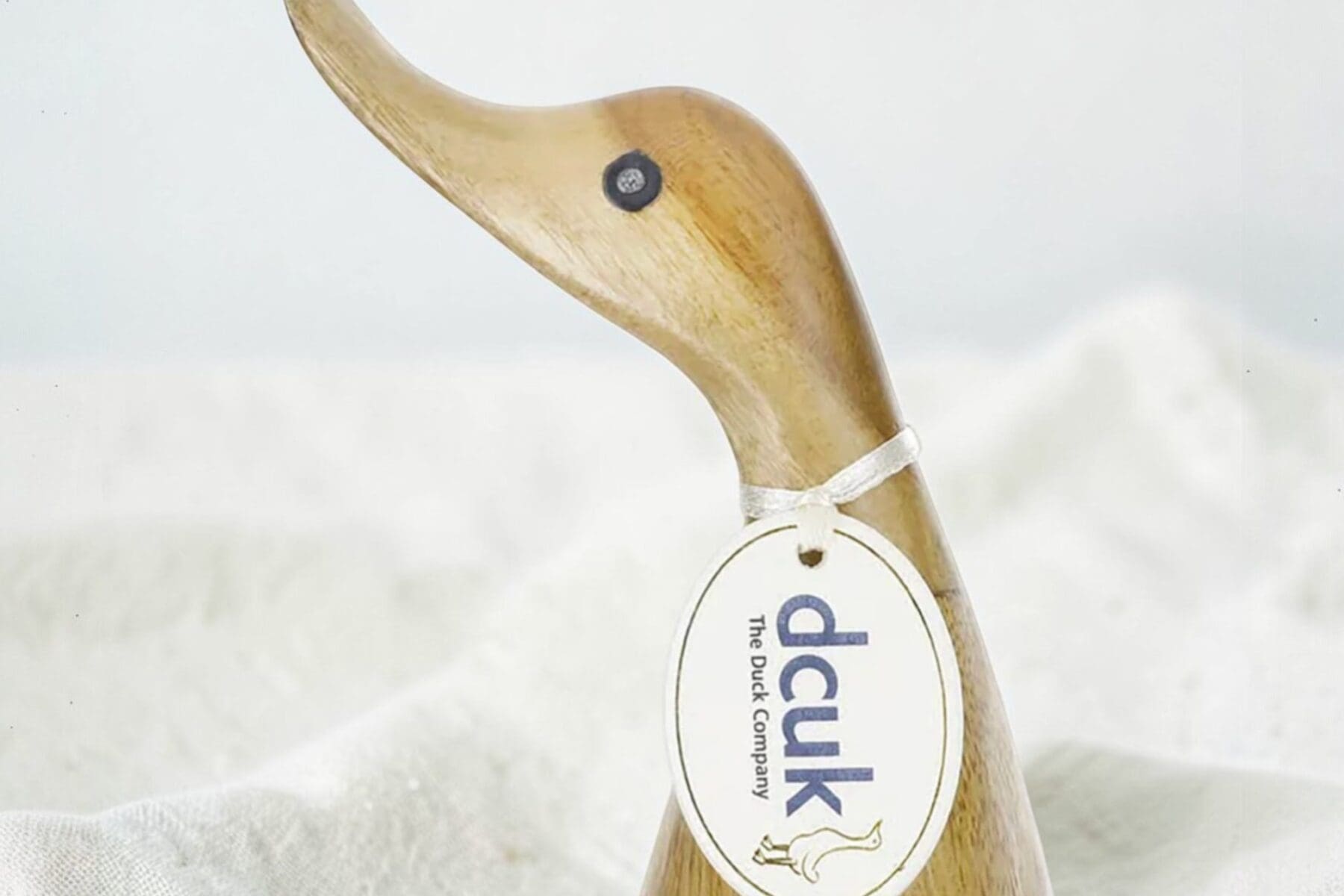
If you’ve come across a DCUK duck on someone’s shelf and found yourself doing a double take, you’re not alone. They have an unusual quality that’s hard to immediately place: part folk art, part natural sculpture, part something-you’d-find-in-a-Devon-cottage. People tend to either walk straight past them or stop completely and pick one up.
This post is for the people who stop.
Where Do They Come From?
DCUK, formally The Duck Company, originally from Devon in southwest England, has been producing handcrafted duck figurines for decades. The brand’s identity is rooted in craft tradition and a very particular sense of humour: ducks dressed in raincoats, ducks perched among toadstools, ducks with expressions that somehow manage to look both dignified and ridiculous at the same time.
The figurines are made in Indonesia by skilled artisans, using a material most people don’t immediately think of when they imagine wood carving.
What Is Bamboo Root, Exactly?
This is the part that surprises most people.
The figurines are not carved from standard timber. They’re made from the root of the bamboo plant — the dense, gnarled, organic mass that sits underground and gives the plant its structural foundation. Bamboo root has a texture and character that ordinary wood doesn’t: it’s irregular, knotted, and visually complex, with natural ridges and grain patterns that vary from piece to piece.
The artisans who make DCUK figurines work with the natural shape of the root rather than against it. The form of the duck emerges from what the material already suggests, rather than being imposed upon a uniform block. This is a fundamentally different approach from mass-produced ornaments, and it’s why every figurine is genuinely unique not in the “minor colour variation” sense that manufacturers use as a disclaimer, but in the sense that no two pieces share the same grain, the same subtle curve, or the same weight in the hand.
Why Are They Priced at a Premium?
This is a fair question, and it deserves a straight answer.
Each figurine is hand-carved and hand-painted by a single artisan. The bamboo root has to be sourced, dried, and selected for its suitability before carving begins. The painted details, the raincoat on a Duckling Raincoat piece, the toadstool caps on the Folk range are applied by hand, brush by brush. There is no mould. There is no production line in the conventional sense.
When you pay $49 to $74 for a DCUK duck, you’re paying for a made object rather than a manufactured one. That distinction is genuinely meaningful, and it’s visible in the piece itself when you hold it.
The pricing also reflects the retail reality in Australia. DCUK is distributed here through a specialist importer, and the figurines arrive in small quantities. They are not the kind of thing you’ll find marked down at a homeware chain. That’s a feature, not a complaint.
Who Buys Them (and Why)?
Based on the profile of DCUK buyers internationally, they tend to fall into a few clear groups.
Gift buyers are the most common. The figurines photograph well, come in quality packaging, occupy a price point that feels generous without being excessive, and have enough personality that they don’t read as generic. For the buyer trying to find something for a person who already has everything, a DCUK duck is a reliable answer.
Collectors come next. DCUK produces seasonal and limited releases alongside the core range, and the hand-variation between pieces means that collectors often seek out specific ducks within a series rather than treating them as interchangeable.
Home decorators who appreciate natural materials and craft objects round out the audience. The figurines sit well in interiors that lean into organic textures, timber furniture, and handmade objects. The kind of home where a commercially printed artwork on a canvas would feel out of place.
The Range Available in Australia
The current range through [your store name] includes three distinct collections:
Natural Wooden Ducklings (D3 range): 18cm figurines in natural bamboo root finishes. These are the most immediate introduction to the material itself, with the grain and texture of the root left largely visible.
Duckling Raincoat Range (D3RAIN): The same 18cm form, hand-painted in a series of raincoat colourways. Each duck in the series has a name and a distinct painted detail. These are the most consistently popular with gift buyers.
Toadstool Folk Duckys (D9TH): A slightly smaller 13cm figurine at a higher price point, justified entirely by the level of hand-applied detail. The toadstool theming places these squarely in woodland folk art territory, and they are the most collectible of the three ranges.
Are They Suitable for Children?
Honest answer: they are not toys. The bamboo root material, the hand-painted finishes, and the small-scale detailing on some pieces make them ornaments for adults and older teenagers rather than items for young children. They are, however, genuinely appealing to children in the way that beautiful handmade objects often are, they just belong on a shelf rather than in a toy basket.
Where Can I See Them?
The full current range is available at dcuk.com.au, with detailed photography that attempts to capture the grain variation and hand-painted detail of each piece. Given that every figurine is unique, the photography shows representative examples rather than exact replicas of what you’ll receive, which is part of the point.